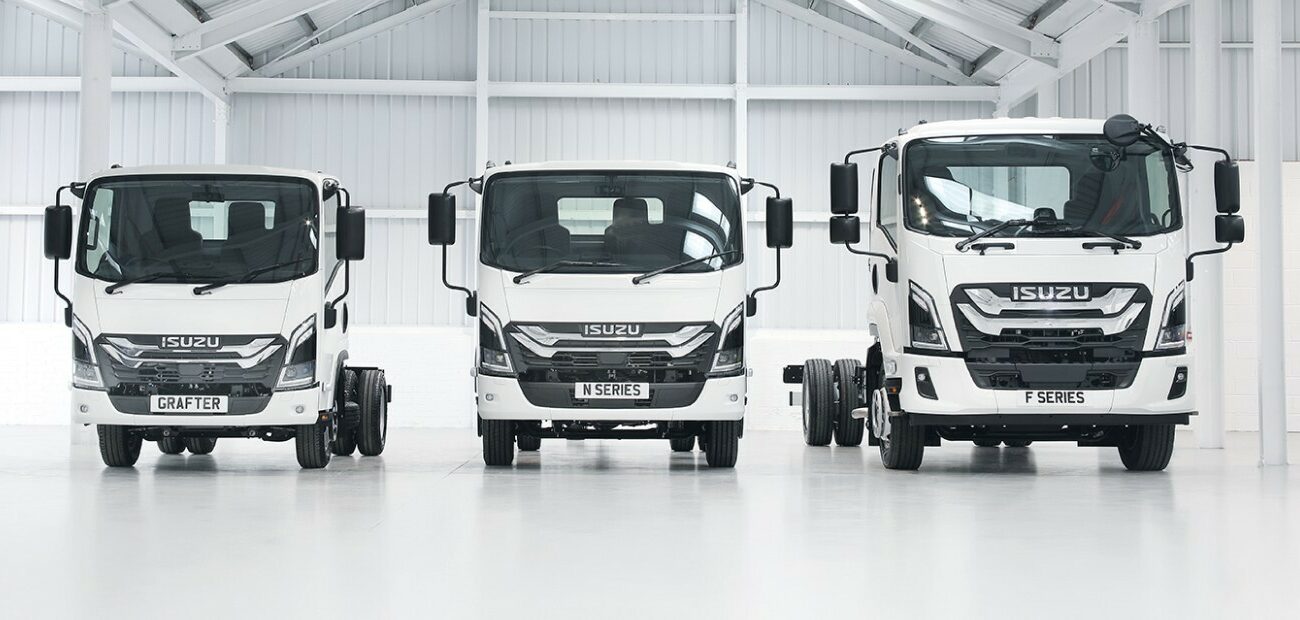
Isuzu has just pulled the wraps off its biggest UK product change in three decades. The new P700 range had its first UK public showing at Road Transport Expo 2026, and it touches almost every part of the line-up: new cab technology, a new gearbox, an extra engine option, and a 6.5 tonne crew cab that’s brand new to the range.
It’s making its way over to UK dealerships soon, with order books already open. In the build up, here’s what we know about the range.
Why the range was launched
The P700 range has already begun to roll out across Japan, North America and Australia, and the UK version builds on what Isuzu has already learned from those markets. Managing Director, Peter Murphy has said that the update is about ‘giving customers more choice, with several new model variants introduced to widen the range’s appeal’.
The time lines up with wider changes in UK road safety policy too. In July 2026, the government confirmed it will mandate a set of vehicle safety technologies through GB type approval, several years after similar rules came into force across the EU. Features like blind spot detection and traffic sign recognition, already built into the P700 as standard, put Isuzu ahead of where the regulation is heading rather than scrambling to catch up later.
What the range includes
Three chassis weights were on show at RTX: a 3.5 tonnes, 7.5 tonnes, and 13.5 tonnes. Across those weights, Isuzu offers narrow, day and crew cab configurations, so buyers can match the cab to the job.
Sitting alongside those is a new addition: a 6.5 tonne crew cab. It slots between the 3.5 tonne and 7.5 tonne options, giving operators who need to carry a full crew a lighter-weight choice than the existing 7.5 tonne crew cab.
P700 is the name for the whole update rather than a new model line. Underneath it, the familiar Isuzu names stay put – Grafter at 3.5 tonnes, N-Series up to 7.5 tonnes, and F-Series at 11 to 13.5 tonnes. It’s the models that fleets already trust, sharpened up underneath.
The model breakdown
Each weight in the range is built with a different job in mind. Here’s a closer look at where each one fits.
3.5T Grafter
This is Isuzu’s best known model in the UK, and for good reason. It can be driven on a standard category B license, which keeps it accessible to a wider pool of drivers than anything heavier, and its compact forward-control cab makes light work of tight streets and narrow lanes. It’s slightly lighter than the outgoing model too, which counts for something on a chassis where every kilo of payload matters. It’s most commonly seen as a tipper, either with a standard steel-floor body, an arb tipper for tree surgeons or a caged version for waste and recycling work. Groundworkers, scaffolders, landscapers and local authority teams are the typical buyers, and its size makes it a sensible fit for low emission zone work too.
6.5 tonne crew cab
New to the range, and new to Isuzu at this weight, this crew cab offers searing for a full gang, so it sits well with highway maintenance teams, utilities and rail crews, and anyone who needs to carry both people and a tipper, dropside or cafe body to site. It gives operators who need a crew cab, but don’t need the size or running costs of the 7.5 tonne version, a lighter option that wasn’t available before.
7.5 tonne N-Series
Isuzu’s strongest seller in the UK, and the range where it’s built its reputation. The combination of high payload and low unladen weight makes it a natural fit for weight sensitive work: tippers, box vans, curtainsiders and refrigerated bodies all sit comfortably at this weight. There’s also a new 175 PS engine option joining the range, sitting between the two existing engines for operators who want more power without stepping up to the larger unit and losing payload in the process. The crew cab version, in particular, has become the standard choice for vehicle recovery, fitted with slidebed or twin-deck recovery equipment to clear breakdowns and transport multiple vehicles at once.
13.5 tonne F-Series
The largest chassis in the range, built for businesses that have outgrown the 7.5 tonne but still want a compact cab and easy loading height. A new longer wheelbase option has been added too, giving five wheelbase lengths to choose from and more flexibility for working with longer bodies. It works for scaffolding firms, curtainside distribution work, and beavertail bodies for transporting plant and machinery. It’s also used in heavier recovery work, where the extra payload allows for bigger, more capable recovery equipment.
New features bought in
The engine and wheelbase changes under each model are only part of the story. There’s also a new gearbox, a step up in standard equipment, and a set of safety systems fitted across the range.
The nine-speed ISIM gearbox
ISIM stands for Isuzu Smooth Intelligent Transmission, and it’s a dual clutch gearbox, a first for Isuzu in the UK. The practical difference from a standard automated manual comes down to how it changes gear. A single clutch system briefly interrupts drive with every shift, which is why older automated trucks can feel like they nod or hesitate between gears. A dual-clutch box has the next gear already selected and ready to go, so the change happens almost without a pause. With nine gears to work with instead of six, the engine can also sit at lower revs more of the time, which helps with fuel economy and makes for a quieter cab on long routes.
Standard equipment
LED lighting, air-conditioning and satellite navigation now come as standard across the range, along with an infotainment system that supports Apple CarPlay and Android Auto. It’s a meaningful step up from what used to be optional extras, bringing more of a focus on driver comfort.
Safety systems
Four new systems are being introduced across applicable models:
- Blind Spot Information System (BSIS) watches the nearside for cyclists and pedestrians and warns the driver as the risk increases, which matters most at junctions and when turning left in town.
- Distance Warning System (DWS) alerts the driver if they’re following too closely or closing in on the vehicle in front, helping to avoid rear-end collisions.
- Traffic Sign Recognition (TSR) reads road signs and displays them on the dashboard, so a change in speed limit or a restriction is harder to miss on an unfamiliar route.
- Tyre Pressure Monitoring System (TPMS) keeps a constant check on tyre pressure and flags a slow puncture before it becomes a bigger problem, which protects both uptime and fuel economy.
What happens next:
Order books are already open, so if you’re planning ahead, there’s no need to wait for stock to arrive before registering interest.
Production of right hand drive P700 models starts in Japan, with the first chassis expected to reach UK bodybuilders later in the year. From there, each truck still needs its body fitted before it’s ready for the road, so timelines will vary depending on what you’re having built.
Talk to Norfolk Truck & Van
If the P700 range sounds like the right fit for your next fleet addition, now’s a good time to get in touch. We can register your interest ahead of stock arriving, and talk you through which model and cab configuration would suit the work you’ve got coming up.
We’re also registered dealers for the current Isuzu range, so if you’re looking for something sooner, there’s still a route to get you moving without a wait.
Get in touch with your local depot in Norwich (01603 253 300), Ipswich (01473 834200) or London (0208 804 1266).